
Phase II Environmental Site Assessment: A Complete Guide for Commercial Real Estate Transactions
What Is a Phase II Environmental Site Assessment?
A Phase II Environmental Site Assessment (Phase II ESA) is an environmental investigation performed to determine whether contamination is present at a commercial property. It typically involves collecting soil, groundwater, or soil vapor samples and testing them in a laboratory to evaluate conditions identified during an earlier Phase I Environmental Site Assessment (Phase I ESA).
A Phase II ESA does not automatically mean a property is contaminated. It is a fact-finding step that answers a specific question: does this property present an actual environmental risk, or was the concern raised in the Phase I ESA based on incomplete historical information?
Many buyers assume a Phase II ESA is ordered because contamination is suspected. In practice, it is often recommended because historical records could not fully explain a past use, an adjoining property's history, or a gap in the chain of title. Sampling answers questions that records alone cannot.
KEY TAKEAWAY
A Phase II ESA provides physical, laboratory-confirmed data about subsurface conditions. It replaces assumption with evidence, which is exactly what a lender, buyer, or attorney needs before closing.
Why Is a Phase II ESA Recommended?
A Phase II ESA is recommended when a Phase I ESA identifies a Recognized Environmental Condition (REC) that cannot be resolved through records review alone. A REC is a term used in environmental due diligence to describe evidence of a past or current release of hazardous substances or petroleum products at a property.
Common examples include former dry cleaners, gasoline stations, auto repair shops, and industrial manufacturing operations. A REC does not confirm that contamination exists. It means the property's history includes activities commonly associated with environmental risk, and sampling is the only way to know for certain.
BOTTOM LINE
An REC is a flag for further investigation, not a diagnosis. A Phase II ESA is how that flag gets resolved with data instead of speculation.
What Triggers a Phase II ESA?
Several situations commonly lead a lender, buyer, or attorney to request a Phase II ESA:
A Phase I ESA identifies one or more RECs on the subject property or an adjoining property.
A commercial lender requires additional environmental due diligence as a condition of financing.
The property has a documented history of industrial, manufacturing, or fuel-related use.
The buyer plans to redevelop the site for a more sensitive use, such as residential, educational, or healthcare occupancy.
Open regulatory case files, prior spill reports, or agency records exist for the property or nearby sites.
WHY IT MATTERS
Any one of these conditions can affect financing timelines, purchase price negotiations, or redevelopment plans. Identifying the trigger early lets a buyer build the investigation into the transaction schedule instead of reacting to it later.
What Does a Phase II ESA Involve?
A Phase II ESA is typically performed consistent with the framework outlined in ASTM E1903, the industry standard practice for the Phase II Environmental Site Assessment process. The scope is developed around the specific RECs identified in the Phase I ESA rather than a fixed checklist.
Common elements of a Phase II ESA include:
Developing a sampling and analysis plan based on the property's history and suspected contaminants.
Advancing soil borings to collect soil samples at depths relevant to the site's history.
Installing groundwater monitoring wells when groundwater conditions or the investigation's objectives require it.
Collecting soil vapor samples when vapor intrusion into existing or future buildings is a potential concern.
Submitting samples to an accredited laboratory for analysis of petroleum hydrocarbons, metals, solvents, or other relevant constituents.
Comparing laboratory results to applicable state or federal regulatory screening levels.
For a step-by-step walkthrough of what happens during each stage of the investigation, see the Phase II ESA Process article in this series.
WHAT THIS MEANS FOR YOUR PROJECT
The scope of a Phase II ESA is shaped by the property's specific history, not a one-size-fits-all template. An experienced environmental consultant tailors the investigation to the RECs at hand, which keeps costs focused and results defensible.
How Long Does a Phase II ESA Take, and What Does It Cost?
Most Phase II Environmental Site Assessments commonly takes four to eight weeks from initial scoping to a final report, though timelines vary based on site access, laboratory turnaround times, and the complexity of the environmental conditions being evaluated. Cost varies just as widely, depending on the number of sample locations, subsurface conditions, and the laboratory analyses required.
Because both timeline and cost depend heavily on site-specific factors, they are addressed in more detail in the Phase II ESA Cost and Phase II ESA Timeline articles in this series.
What Happens If Contamination Is Found?
Finding contamination during a Phase II ESA does not necessarily end a transaction. It typically shifts the conversation toward how the contamination will be managed, who is responsible for it, and how that responsibility is allocated between buyer and seller.
Depending on the extent and nature of the contamination, next steps may include additional delineation sampling, a remedial cost estimate, negotiation of a purchase price credit or escrow holdback, or enrollment in a state voluntary cleanup or brownfield program. Contamination that is documented and appropriately managed frequently does not prevent a deal from closing.
WHY IT MATTERS
Lenders and buyers are generally less concerned with whether contamination exists than with whether it is understood, quantified, and addressed through a defensible plan. Clear data supports informed negotiation rather than uncertainty.
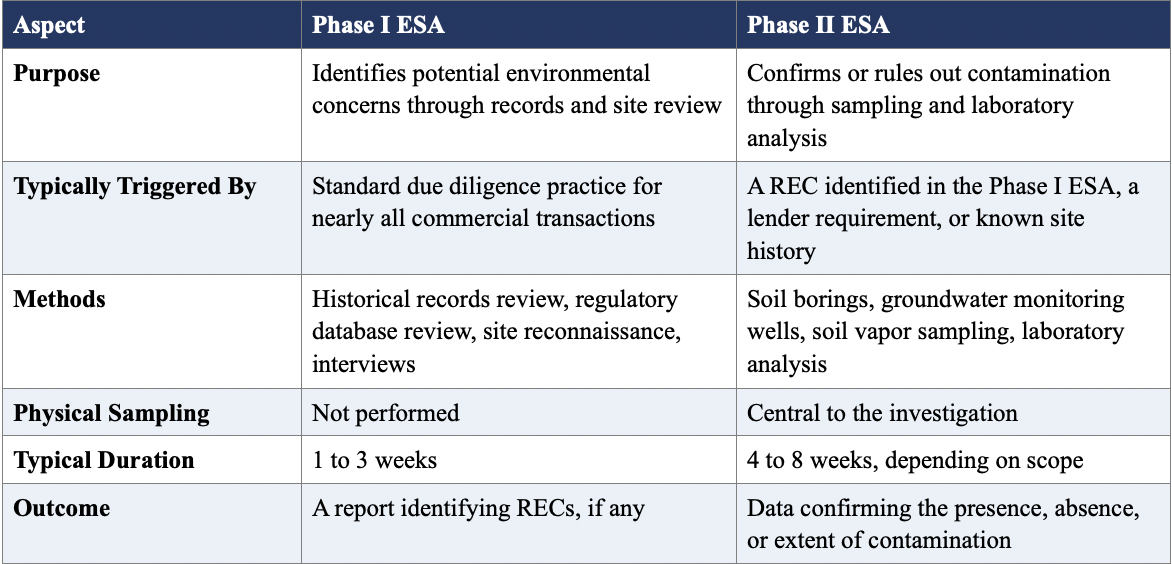
Phase I ESA vs. Phase II ESA: What's the Difference?
The two assessments serve different purposes and are performed at different points in a transaction:
Who Typically Requests a Phase II ESA?
Phase II ESAs are most often requested by commercial lenders financing the transaction, buyers seeking to understand risk before closing, and real estate attorneys managing liability exposure. Municipalities and agencies overseeing brownfield redevelopment also rely on them, as do property owners and asset managers who order a Phase II ESA proactively before refinancing, redeveloping, or selling a property with a known environmental history.
What Does This Mean for Your Transaction?
A Phase II ESA gives every party at the table the same thing: verified information instead of assumptions. For buyers, it clarifies risk before capital is committed. For lenders, it satisfies underwriting requirements tied to collateral value. For sellers, it can resolve open questions that would otherwise stall a deal.
If your Phase I ESA has identified a Recognized Environmental Condition, an experienced environmental consultant can help determine the appropriate scope for a Phase II ESA based on your property's history, transaction timeline, and redevelopment plans.
Choosing the Right Environmental Consultant
Selecting the right consultant is crucial for a successful Phase II ESA. Experienced professionals bring specialized knowledge and skills to the table. Their expertise directly impacts the quality of the assessment.
When choosing a consultant, consider the following factors:
Experience
Seek consultants with a proven track record.
Credentials
Ensure they hold necessary certifications and licenses.
Reputation
Opt for professionals with positive client feedback and references.
A well-chosen consultant navigates complexities efficiently, ensuring compliance and thorough investigations. Proper selection leads to clearer insights and better strategic planning.
Frequently Asked Questions About Phase II ESAs
What is a Phase II Environmental Site Assessment (Phase II ESA)?
A Phase II Environmental Site Assessment (Phase II ESA) is a subsurface investigation that collects and analyzes samples (typically soil, groundwater, and sometimes soil vapor) to confirm whether contamination is present and, if so, at what concentrations.
What is the difference between a Phase I ESA and a Phase II ESA?
A Phase I ESA identifies potential environmental concerns using records review, site reconnaissance, and interviews. A Phase II ESA is performed when concerns are identified and involves sampling and laboratory testing to confirm contamination.
When is a Phase II ESA required?
A Phase II ESA is commonly required when a Phase I ESA identifies Recognized Environmental Conditions (RECs), when lenders or buyers require confirmation testing, or when there is a known or suspected release (for example, petroleum, solvents, or metals).
What does a Phase II ESA include?
A Phase II ESA typically includes a sampling and analysis plan, fieldwork (soil borings, monitoring wells, soil vapor probes as needed), laboratory testing, data evaluation, and a written report with findings and recommendations.
What is a Phase II ESA investigation (Phase II investigation)?
A Phase II ESA investigation (also called a Phase II investigation or Phase 2 ESA) is the on-site portion of the work where environmental professionals collect samples to evaluate whether contaminants are present in the subsurface.
What is a subsurface investigation in a Phase II ESA?
A subsurface investigation is fieldwork performed below ground surface to evaluate soil and groundwater conditions. It may include drilling soil borings, installing groundwater monitoring wells, collecting groundwater samples, and collecting soil vapor samples when vapor intrusion is a concern.
How much do Phase II Environmental Site Assessment costs typically range?
Phase II Environmental Site Assessment costs vary based on the scope of sampling, number of locations, contaminants of concern, and laboratory analysis needs. Many projects fall between $5,000 and $50,000, but complex sites can be higher.
What factors increase Phase II ESA costs?
Phase II ESA costs generally increase with larger properties, more sampling locations, deeper drilling, multiple contaminants (for example, VOCs plus metals), expedited laboratory turnaround, difficult site access, and additional investigation rounds.
How long does a Phase II ESA take?
A Phase II ESA often takes several weeks from scoping to final report, but timelines depend on site access, drilling schedules, lab turnaround times, and the complexity of the investigation.
What contaminants are commonly tested during a Phase II ESA?
Common Phase II ESA analytes include petroleum hydrocarbons, VOCs (solvents), SVOCs, PAHs, heavy metals, PCBs, and (when applicable) PFAS. The target list should be tailored to site history and Phase I ESA findings.
What happens if contamination is found during a Phase II ESA?
If contamination is confirmed, next steps may include additional delineation, risk evaluation, regulatory consultation, and development of a remediation plan. The Phase II ESA report supports informed decisions on cleanup, transaction terms, or redevelopment strategy.
Do lenders and investors use Phase II ESA results in due diligence?
Yes. Lenders, investors, and buyers commonly use Phase II ESA results to evaluate environmental liability, inform deal structure, estimate remediation costs, and determine whether to proceed with a transaction.
Who performs a Phase II ESA?
A Phase II ESA should be performed by qualified environmental professionals with experience in site characterization, sampling, and interpretation of regulatory screening levels and risk-based criteria.
Can CRB help with a Phase II ESA and subsurface investigation?
Yes. CRB supports Phase II ESA scoping, subsurface investigation, sampling and laboratory coordination, reporting, and clear recommendations so you can move forward with confidence.