

Aquifer Analysis & Groundwater Modeling Services
Groundwater plays a critical role in environmental planning, site development, remediation design, and water resource management. Whether you are evaluating natural site conditions, designing dewatering systems, modeling contaminant transport, or supporting regulatory decisions, understanding how an aquifer behaves beneath a site is essential.
At CRB, we help clients evaluate and interpret subsurface water systems using technically sound, scientifically defensible aquifer analysis and groundwater modeling. Our work supports engineering design, regulatory compliance, remediation planning, and long-term resource management decisions.
What Aquifer Analysis Is and Why It Matters
Aquifer analysis is the practice of evaluating groundwater systems to understand how water and dissolved constituents move through the subsurface. This includes characterizing:
Hydraulic conductivity and transmissivity
Groundwater flow direction and gradients
Storage properties and recharge conditions
Interaction between groundwater and surface water
How contaminants migrate over time
These evaluations are critical for:
Designing effective remediation systems
Planning construction dewatering
Evaluating land use and development impacts
Supporting water supply and resource management
Performing fate and transport modeling for regulatory decision-making
Without a proper hydrogeologic understanding, engineering designs and cleanup strategies are often over- or under-designed, increasing cost, risk, and uncertainty.
CRB’s role is to provide site-specific, defensible groundwater interpretation that supports real-world project decisions.
How CRB Conducts Aquifer Analysis & Groundwater Modeling
CRB’s aquifer analysis work begins with a careful review of site conditions, geology, historical data, and project objectives. From there, we design field investigations and modeling approaches that are appropriate to the complexity of the site and the decisions being supported.
Depending on site needs, our services may include:
Aquifer Pumping Tests: Field testing to determine hydraulic properties and aquifer response.
Groundwater Flow & Transport Modeling: Use of analytical and numerical models to simulate groundwater movement and contaminant migration.
Flow Net & Recharge Analysis: Visualization and quantification of flow pathways and recharge mechanisms.
Three-Dimensional Finite Element Modeling: Advanced modeling for complex hydrogeologic settings.
Vadose Zone Analysis: Evaluation of unsaturated zone infiltration, vapor transport, and solute migration.
Groundwater Resource Management Studies: Development of monitoring networks, supply models, and long-term management strategies.
We integrate site-specific geology, hydrogeology, and engineering requirements into models and interpretations that support design, regulatory review, remedial planning, and resource management.
From Technical Analysis to Practical Insight
Collecting data and running models is only part of the process. The real value of aquifer analysis lies in interpreting results in a way that supports decisions.
When CRB performs aquifer analysis and groundwater modeling, you receive:
Clear interpretation of groundwater flow systems
Defensible technical analyses and regulator-ready reports
Practical recommendations tied to your project objectives
Models and visualizations that communicate complex subsurface conditions
Quantitative support for feasibility studies, engineering design, and compliance documentation
Our focus is not just on producing models — it is on helping you use groundwater science to move projects forward.
Understand Subsurface Conditions and Make Confident Water-Related Decisions

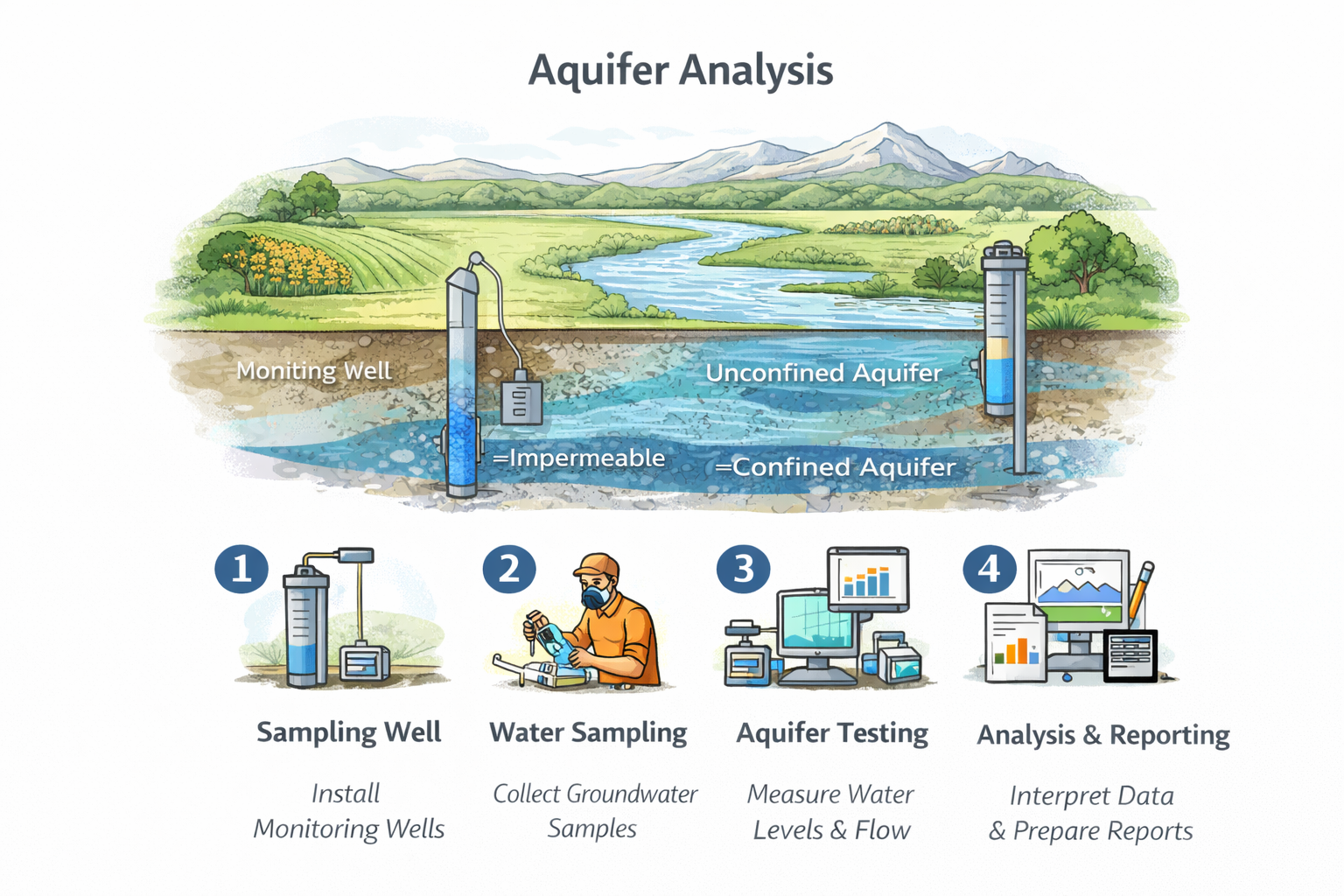
The CRB Aquifer Analysis Assessment Process
-
We evaluate geology, historical data, and project goals.
-
We perform pumping tests, install wells, and collect hydrogeologic data.
-
We simulate flow and transport using appropriate analytical or numerical models.
-
We prepare defensible reports and provide practical recommendations.
Sound groundwater decisions require more than assumptions, they require defensible hydrogeologic analysis.
Talk to a CRB environmental professional today and get the data you need to move forward with confidence.
Ready to Understand Your Groundwater System?

Frequently Asked Questions
-
Aquifer analysis and groundwater modeling are scientific methods used to understand how groundwater moves, how much water is available, and how a project may affect the aquifer.
These studies are used to:
Evaluate water supply capacity
Predict groundwater flow and drawdown
Assess impacts from pumping or development
Support permitting and regulatory approvals
Design dewatering or remediation systems
Protect water resources and nearby properties
-
You may need these services if your project involves:
Large groundwater withdrawals or new water wells
Dewatering for construction
Mining or deep excavation
Landfills or industrial facilities
Environmental remediation systems
Development near sensitive water resources
Regulatory permitting that requires hydrogeologic modeling
If an agency asks for “hydrogeologic support” or “groundwater impact analysis,” this is typically what they mean.
-
Groundwater models are used to:
Predict how groundwater levels will change over time
Evaluate impacts to nearby wells, wetlands, or surface waters
Demonstrate regulatory compliance
Optimize wellfield or dewatering system design
Support water use permits and environmental approvals
Evaluate contamination migration and cleanup strategies
Models help decision-makers see problems before they happen.
-
A pump test involves pumping a well at a controlled rate and measuring how groundwater levels respond.
It helps determine:
Aquifer capacity
Sustainable pumping rates
Aquifer properties
Impacts to nearby wells or resources
Pump test results are often used to build and calibrate groundwater models.
-
Yes. Groundwater modeling is commonly used to:
Predict contaminant migration
Design extraction or injection systems
Optimize cleanup strategies
Support regulatory approval of remediation plans
Reduce long-term cleanup costs