

Phase I Environmental Site Assessments (ESA)
Industry-leading Phase I ESAs that identify recognized environmental conditions (RECs), reduce risk, and support confident decision-making for CRE lenders, developers, and attorneys.
What is a Phase I Environmental Site Assessment (ESA)?
An ASTM-compliant Phase I Environmental Site Assessment is a formal environmental due diligence investigation designed to identify Recognized Environmental Conditions (RECs) in connection with a subject property.
The main purpose is to evaluate environmental risk through careful examination of historical records, federal, state, and local regulatory databases, interviews with knowledgeable persons regarding site use, and the evaluation of current conditions at the subject property and surrounding properties. A Phase I ESA answers a critical question: “Is there reason to believe that soil or groundwater at the subject property is impacted by contamination?”
THE VALUE OF A PHASE I
Identifying Environmental Risk Before You Acquire Property
Every commercial or industrial property has a history — and in many cases, that history includes prior uses that may leave behind environmental contamination that is rarely evident during a normal site visit. Former fuel stations, dry cleaners, manufacturing facilities, agricultural operations, and even seemingly benign commercial operations can create conditions that lead to soil or groundwater contamination, which can only be identified through proper environmental due diligence.
When evaluating a property for purchase, financing, or redevelopment, the greatest risk is often not what you can see — it is what you cannot. Unknown environmental issues at closing can surface at a future date during permitting, construction, or redevelopment and can delay or derail transactions, trigger regulatory obligations, complicate redevelopment plans, impact financing, and create significant, unexpected costs long after a deal has closed.
An ASTM-compliant Phase I Environmental Site Assessment (Phase I ESA) is the industry-standard first step in identifying these risks, known as Recognized Environmental Conditions (RECs), before they become liabilities.

IDENTIFY RISK
Uncover recognized environmental conditions (RECs) that may impact your liability.
SUPPORT DUE DILIGENCE
Meet lender, investor, regulatory requirements.
REDUCE LIABILITY
Qualify for landowner liability protections under CERCLA with proper due diligence.
SAVE TIME AND MONEY
Identify potential issues early and avoid costly surprises down the road.
FACILITATE TRANSACTIONS
Keep deals moving with timely, defensible environmental reports.
CLEAR, ACTIONABLE REPORTS
Receive easy-to-understand reports with findings, conclusions, and actionable next steps.
Who Needs a Phase I ESA?
Prospective buyers evaluating commercial or industrial property acquisitions.
Lenders underwriting or financing real estate purchases and redevelopment projects.
Portfolio managers responsible for property acquisition, oversight, and long-term asset management.
Property developers conducting predevelopment environmental risk evaluations.
Property owners seeking to understand and document the environmental condition of their holdings.
If you are buying, selling, financing, or developing commercial property, a Phase I ESA is one of the most effective environmental risk management tools available in real estate.
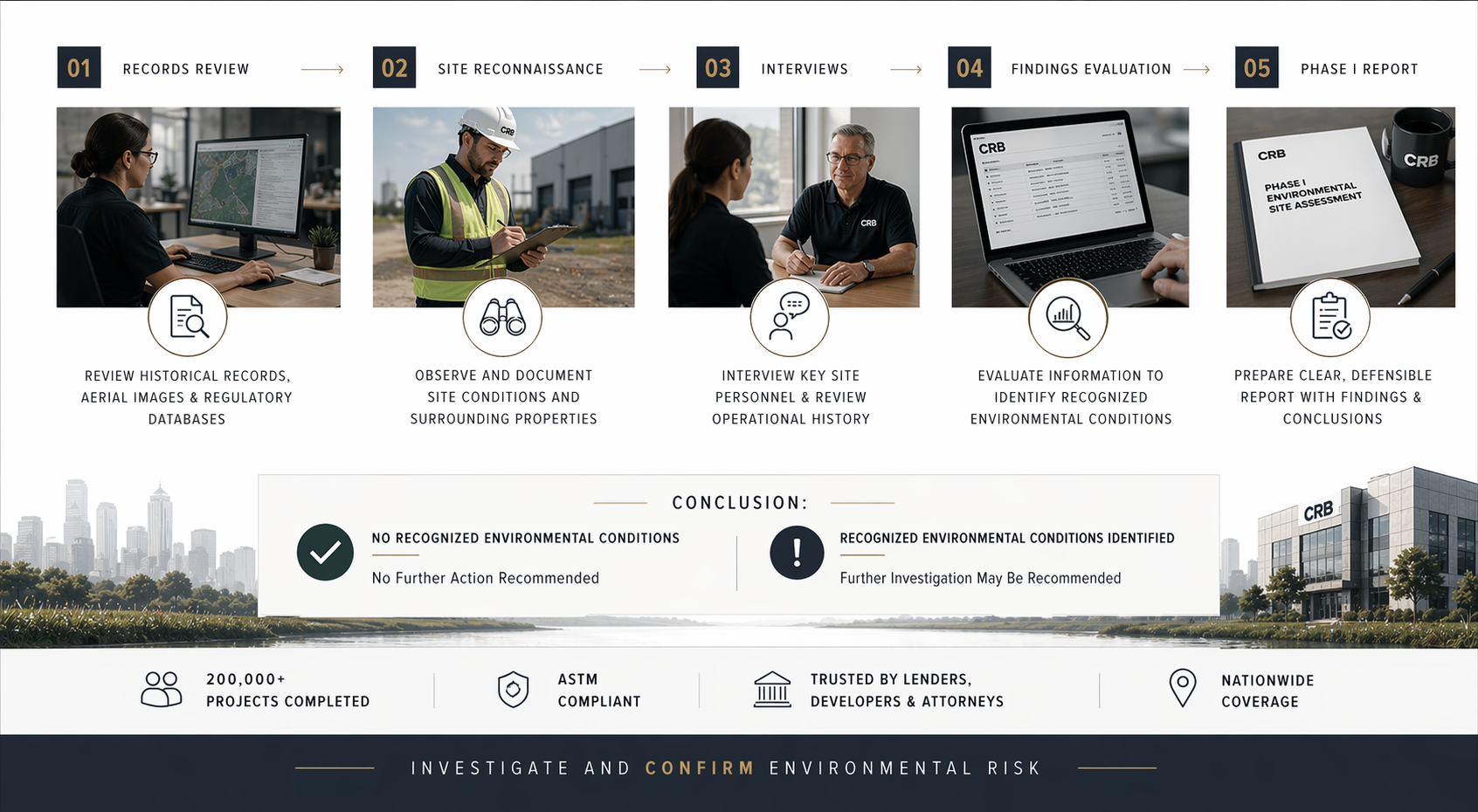
The CRB Phase I ESA Process
-
We begin by defining the project scope and compiling all available site information. This includes initiating historical research, reviewing publicly available documents, and conducting federal, state, and local regulatory database searches. These early steps establish the environmental context of the property and guide the direction of the assessment.
-
CRB professionals conduct a detailed review of historical sources and regulatory records to reconstruct past land uses and identify potential environmental concerns. This phase also includes evaluating prior reports, permits, enforcement actions, and any available operational information relevant to the site.
-
We perform an onsite inspection to observe current conditions, operations, and any indicators of potential releases. Interviews with owners, operators, occupants, and local officials supplement the site visit and help clarify historical and operational details that may not be captured in written records.
-
We prepare a clear, defensible Phase I ESA report in accordance with ASTM E1527-21 standards, summarizing findings, identifying Recognized Environmental Conditions (RECs), and outlining any recommended next steps. Our reporting is designed to support lenders, attorneys, and buyers with the information they need to move forward confidently and without unnecessary delays.

Get the clarity you need to make confident decisions

Environmental Site Assessment FAQs
-
A Phase I ESA is typically required by lenders, investors, or attorneys during real estate transactions. It is commonly needed for commercial and industrial property purchases, refinancing, portfolio acquisitions, and redevelopment projects.
-
Most Phase I ESAs are completed in 2 to 4 weeks depending on site complexity, records availability, and transaction timelines.
CRB also offers expedited services when projects require faster turnaround.
-
If a Phase I ESA identifies an REC or other concern, the next step is often a Phase II Environmental Site Assessment, which involves soil, groundwater, or vapor sampling to confirm whether contamination is actually present.
-
No. A Phase I ESA is a non-intrusive assessment and does not include soil, groundwater, or air sampling. Sampling is performed during a Phase II ESA if warranted.
-
The cost depends on the size, location, and complexity of the property and surrounding area. CRB provides clear, upfront not-to-exceed pricing and can tailor the scope to meet lender and transaction requirements.
-
Phase I ESAs are most commonly performed for commercial and industrial properties, but they may also be conducted for multi-family or certain residential properties if there is concern about past site use or potential contamination.
-
Our environmental assessments help clients understand potential liabilities and move forward with confidence. Although a Phase I ESA cannot remove all uncertainty, it is a powerful tool for reducing risk and clarifying the environmental profile of a property.