
One of the most common questions asked during environmental due diligence is whether a Phase I Environmental Site Assessment (Phase I ESA) will lead to additional investigation. While many commercial properties successfully complete the Phase I ESA process without further environmental evaluation, certain findings may warrant a Phase II Environmental Site Assessment (Phase II ESA).
Understanding when a Phase I ESA leads to a Phase II ESA can help lenders, developers, investors, attorneys, commercial real estate professionals, and property owners better evaluate environmental risk and make informed transaction decisions.
A Phase II ESA is not automatically required because a Phase I ESA has been completed. Rather, it is typically recommended when the Phase I ESA identifies information suggesting the potential presence of environmental contamination.
A Phase II ESA may also be recommended when significant environmental uncertainty remains following completion of the Phase I ESA, even if a REC has not been formally identified. Examples may include incomplete historical records, inaccessible portions of the property, undocumented underground storage tank closures, or prior site activities that cannot be adequately verified.
Understanding the Relationship Between Phase I and Phase II ESAs
A Phase I Environmental Site Assessment is designed to identify potential environmental concerns associated with a property through records research, site reconnaissance, regulatory review, and interviews.
The Phase I ESA does not include:
Soil sampling
Groundwater testing
Laboratory analysis
Environmental media collection
Instead, it evaluates whether sufficient evidence exists to suggest environmental risk.
A Phase II ESA serves a different purpose. It is an intrusive investigation that collects environmental samples to determine whether contamination is actually present and, if so, to evaluate its extent.
The Phase I ESA identifies potential concerns.
The Phase II ESA investigates those concerns.
The Most Common Trigger: Recognized Environmental Conditions (RECs)
The most common reason a Phase I ESA leads to a Phase II ESA is the identification of a Recognized Environmental Condition (REC) during the Phase I ESA.
Under ASTM E1527-21, a REC generally refers to:
The presence or likely presence of hazardous substances or petroleum products in, on, or at a property due to a release, likely release, or material threat of a release.
Not all RECs require a Phase II ESA. However, many REC findings warrant additional investigation to better understand environmental conditions at the property.
Related Resource:
What Are Recognized Environmental Conditions (RECs)?
Does a REC Automatically Require a Phase II ESA?
No. One of the most common misconceptions in environmental due diligence is that every REC automatically results in a Phase II ESA.
Environmental consultants evaluate:
Available documentation
Regulatory history
Site conditions
Historical uses
Closure records
Risk significance
In some cases, sufficient documentation exists to demonstrate that environmental concerns have been adequately addressed. In other situations, uncertainty remains, making additional investigation appropriate.
The recommendation for a Phase II ESA is ultimately based on professional judgment, site-specific conditions, and the objectives of the transaction. In many cases, a Phase II ESA is recommended not because contamination is known to exist, but because stakeholders need additional information before proceeding. Developers may require greater certainty before redevelopment, lenders may need additional documentation before funding, and purchasers may want to better understand potential environmental liabilities before closing. The objective is often to reduce uncertainty rather than confirm contamination.
Common Reasons a Phase I ESA Leads to a Phase II ESA
While every property is unique, certain environmental conditions and historical site activities more frequently result in recommendations for a Phase II Environmental Site Assessment. The purpose of the Phase II is not to confirm that contamination exists, but rather to evaluate environmental conditions when sufficient uncertainty or potential risk has been identified during the Phase I ESA process.
Historical Gas Stations
Current or former gas station properties are among the most common triggers for additional environmental investigation. Petroleum releases associated with underground storage tanks, fuel dispensers, piping systems, and historical fuel handling activities can impact soil and groundwater. Even when fuel systems have been removed, environmental consultants often evaluate whether sufficient documentation exists to demonstrate that environmental conditions were adequately addressed.
Dry Cleaning Operations
Many dry cleaning facilities historically utilized chlorinated solvents that can persist in soil and groundwater for decades. Because these compounds can migrate beyond property boundaries and may present vapor intrusion concerns, properties with current or historical dry cleaning operations frequently warrant additional environmental evaluation.
Underground Storage Tanks
The presence of current or historical underground storage tanks (USTs) often prompts further investigation, particularly when closure documentation is incomplete or unavailable. Environmental professionals may recommend soil or groundwater sampling to determine whether petroleum releases occurred and whether any environmental impacts remain.
Former Industrial Uses
Properties with historical manufacturing, processing, warehousing, or industrial operations may have utilized hazardous materials, petroleum products, solvents, or waste handling practices that create potential environmental concerns. Depending on the nature of prior operations, a Phase II ESA may be recommended to evaluate whether historical activities have affected environmental conditions at the site.
Off-Site Migration and Adjacent Property Concerns
Environmental concerns identified during a Phase I ESA are not always associated with activities that occurred on the subject property itself. In some cases, potential environmental impacts may originate from neighboring or nearby properties.
Examples may include adjoining gas stations, dry cleaning facilities, automotive repair operations, industrial sites, or properties with documented environmental releases. Depending on site conditions, contaminants can migrate through soil, groundwater, or vapor pathways beyond the original source area.
When a Phase I ESA identifies evidence suggesting that environmental conditions from an adjacent property may have affected the subject property, additional investigation may be recommended to better understand the potential risk. A Phase II ESA can help determine whether environmental impacts are present and whether further evaluation or risk management measures are warranted.
Because contamination does not always respect property boundaries, adjacent property concerns are a common reason environmental professionals recommend additional due diligence during commercial real estate transactions.
How Lenders Influence Phase II Decisions
Lenders often play an important role in determining whether additional investigation is necessary.
When a REC is identified, lenders may request:
Additional environmental documentation
Regulatory closure records
Environmental sampling
Phase II ESA investigations
Financial institutions use environmental due diligence to better understand potential liabilities associated with collateral properties. While lender requirements vary, many institutions prefer additional investigation when significant environmental uncertainty exists.
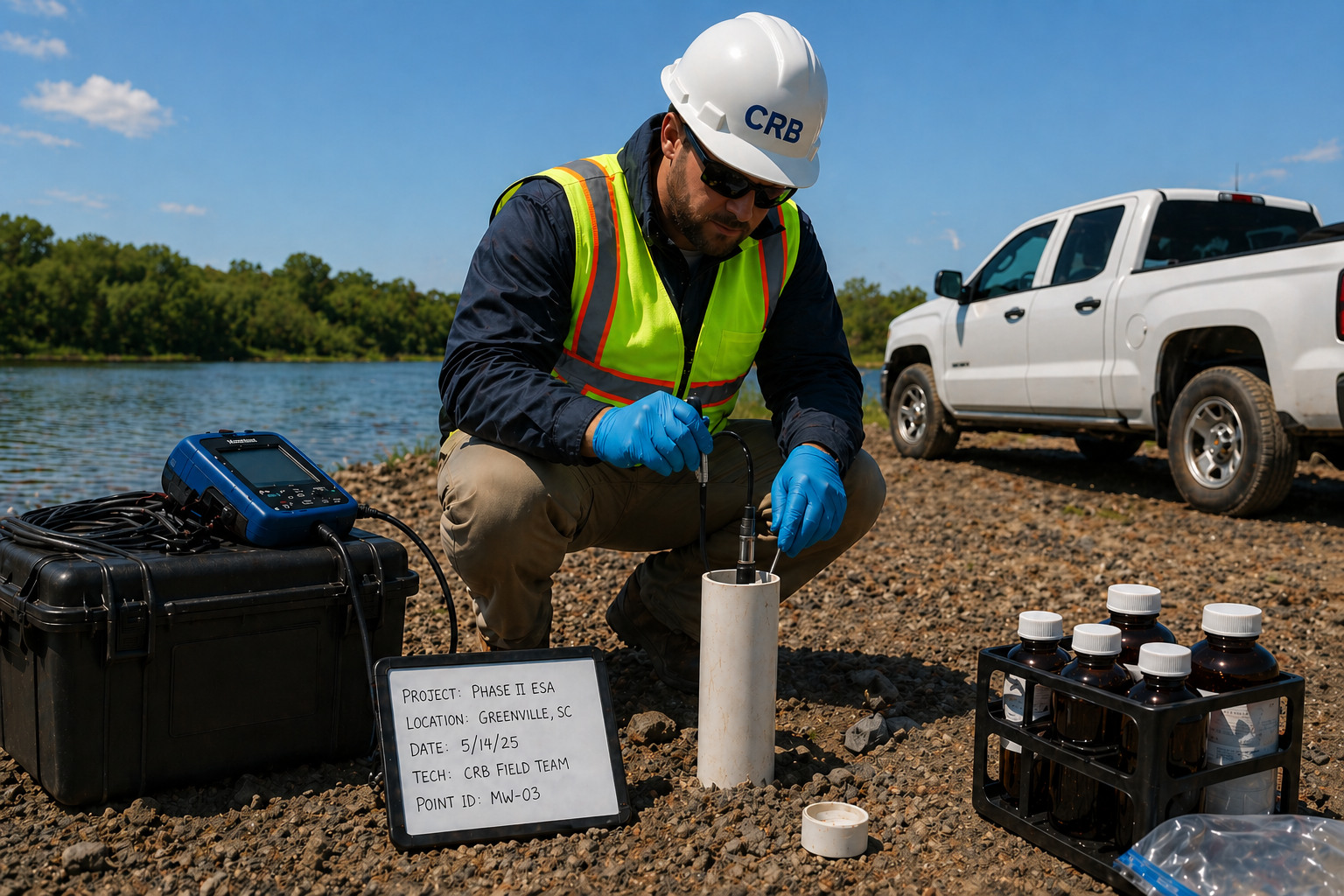
What Happens During a Phase II ESA?
A Phase II Environmental Site Assessment is designed to evaluate whether contamination is present.
Depending on site conditions, a Phase II ESA may include:
Soil Sampling
Environmental professionals collect soil samples from targeted areas identified during the Phase I ESA.
Groundwater Sampling
Monitoring wells may be installed to evaluate groundwater quality.
Vapor Intrusion Evaluation
In certain situations, environmental consultants may assess whether volatile contaminants could migrate into indoor environments.
Laboratory Analysis
Samples are submitted to certified laboratories for chemical analysis.
The analytical program depends on the contaminants of concern identified during the Phase I ESA process.
What If Contamination Is Found?
The presence of contamination does not necessarily prevent a transaction from moving forward.
Depending on the findings, potential outcomes may include:
No additional action required
Limited corrective measures
Environmental remediation
Regulatory coordination
Risk management strategies
Transaction modifications
Many commercial real estate transactions successfully close despite environmental concerns, provided those concerns are properly understood and managed.
A Phase II ESA is not performed because a property is known to have contamination. It is performed because stakeholders need greater certainty before making important business decisions.
Whether the concern involves a REC, historical site activity, an adjacent property, or incomplete documentation, the goal of additional investigation is to better understand environmental conditions and reduce uncertainty. In commercial real estate transactions, having that information early often leads to better decisions, fewer surprises, and a smoother path forward.