
Phase I Environmental Site Assessments in Idaho
CRB provides environmental consulting services across Idaho, including Phase I and Phase II Environmental Site Assessments (ESA), environmental due diligence, remediation, and regulatory compliance.
Core Environmental Services in Idaho
Phase I Environmental Site Assessments (ESA)
Phase II Environmental Site Assessments
Environmental Remediation and Corrective Action
Regulatory Compliance and Reporting
Indoor Air Quality and Environmental Investigations
Aquifer Analysis and Groundwater Evaluation
Asbestos and Mold Assessment & Mitigation
Phase I ESA, Environmental Due Diligence & Remediation in Idaho
CRB provides environmental consulting services across Idaho, including Phase I and Phase II Environmental Site Assessments (ESA), environmental due diligence, remediation, and regulatory compliance support for commercial real estate and development projects.
Phase I Environmental Site Assessments are a core part of our work, supporting property transactions, lending requirements, and risk evaluation. Our team helps identify potential environmental concerns early, navigate regulatory considerations, and deliver practical, defensible solutions for complex site conditions.
Environmental Due Diligence Experts
While CRB provides a wide range of environmental consulting services nationwide, each office focuses on the services most relevant to the environmental conditions and development activity in its region. In Idaho, commercial real estate transactions frequently require environmental due diligence, which is why the CRB Idaho office specializes in Phase I Environmental Site Assessments.
CRB provides ASTM-compliant Phase I Environmental Site Assessments throughout Idaho to support commercial property acquisitions, financing, redevelopment projects, and environmental risk management. Our assessments help buyers, lenders, attorneys, and developers identify potential environmental concerns before a transaction closes.
Properties across Idaho often have complex histories tied to agriculture, industrial activity, underground storage tanks, and former manufacturing operations. A Phase I ESA evaluates historical land use, regulatory records, and current site conditions to determine whether environmental risks may be present.
All CRB Phase I Environmental Site Assessments are performed in accordance with ASTM E1527-21 standards and the EPA’s All Appropriate Inquiry (AAI) rule, providing clear, defensible reports that help project teams move forward with confidence.
Phase I ESAs Are Commonly Required During:
Commercial Real Estate Transactions
Property Financing and Refinancing
Redevelopment Projects
Industrial Property Acquisitions
Supporting Development and Environmental Due Diligence in Idaho
Idaho continues to see growth in commercial development, industrial operations, and land transactions.
Environmental investigations in Idaho often involve coordination with regulatory agencies such as the Idaho Department of Environmental Quality (IDEQ) and the U.S. Environmental Protection Agency (EPA).
CRB understands the regulatory framework governing environmental due diligence, site investigation, and redevelopment projects throughout Idaho.
CRB performs environmental consulting services in Boise, Meridian, Nampa, Idaho Falls, Twin Falls, Coeur d’Alene, and surrounding communities, supporting projects across Idaho and the broader region.
Environmental due diligence often involves evaluating risks related to:
Historic mining operations
Agricultural chemical use
Underground storage tanks
Industrial redevelopment sites
Phase I ESA Idaho
Records Review & Regulatory Database Research
Environmental professionals review federal, state, and local regulatory databases to identify properties that may have experienced environmental releases or contamination. Historical regulatory listings, underground storage tank records, hazardous waste records, and other environmental databases are evaluated to determine identify potential environmental conditions associated with the property or nearby sites.
Historical Property Analysis
Historical sources such as aerial photographs, Sanborn fire insurance maps, city directories, building permits, and topographic maps are reviewed to understand how the property and surrounding area have been used over time. This step helps identify past activities that may have introduced environmental contaminants.
Site Reconnaissance& Documentation
A qualified environmental professional conducts a visual inspection of the property and surrounding areas. The site visit evaluates current conditions that may indicate environmental concerns, such as staining, distressed vegetation, storage tanks, chemical storage areas, waste handling practices, or other indicators of potential contamination.
Interviews with Owners or Operators
Interviews are conducted with property owners, site operators, or individuals familiar with the property's history. These discussions can provide important insight into past operations, historical uses, environmental incidents, or site activities that may not be fully documented in records.
Environmental Risk Evaluation
Information gathered during the records review, historical analysis, site inspection, and interviews is evaluated to determine whether recognized environmental conditions (RECs) are present. Environmental professionals assess the significance of potential concerns and determine whether additional investigation may be warranted.
Phase I ESA Reporting & Recommendations
The findings of the assessment are compiled into a comprehensive Phase I Environmental Site Assessment report. The report documents the environmental history of the property, summarizes identified risks, and provides recommendations if additional investigation—such as a Phase II ESA involving soil or groundwater sampling—may be necessary.
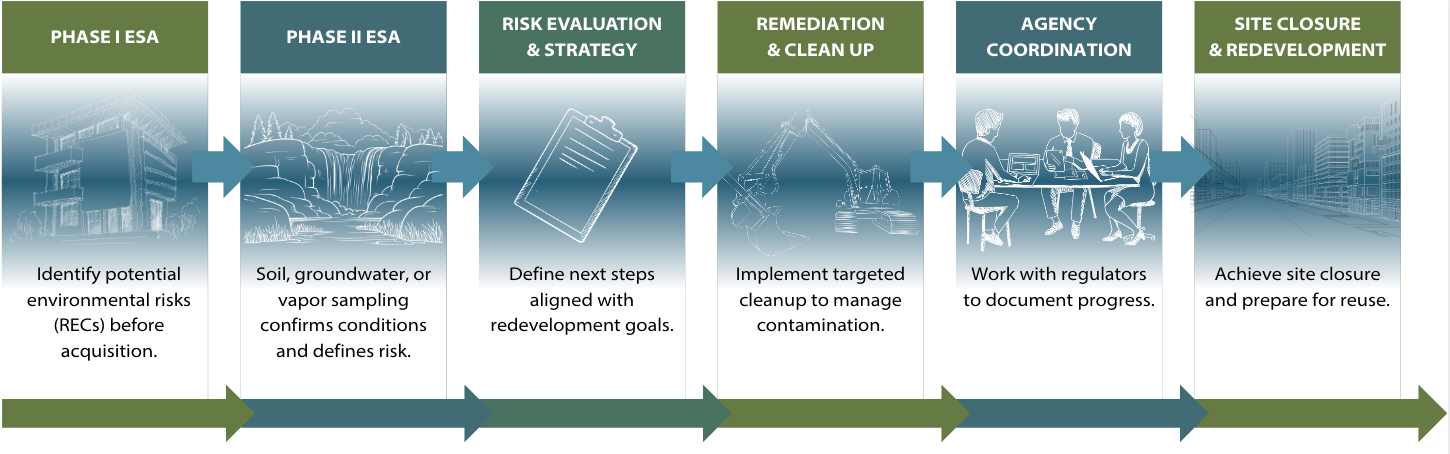
CRB Environmental Consulting Process:
From Due Diligence to Site Closure, We Manage the Entire Process

Why Developers and Lenders Choose CRB Idaho
for Phase I Environmental Site Assessments
• Senior-level environmental professionals leading every project
• Fast turnaround aligned with transaction deadlines
• Reports structured for lenders, attorneys, and regulators
• Nationwide experience with complex real estate transactions
• Clear recommendations when potential environmental risks are identified
Properties Commonly Requiring
Phase I Environmental Site Assessments
CRB supports environmental due diligence for a wide range of properties including:
• Industrial and manufacturing facilities
• Commercial real estate developments
• Agricultural land acquisitions
• Gas stations and automotive facilities
• Apartment and mixed-use developments
• Redevelopment and Brownfields projects
Additional CRB Environmental Due Diligence Services
Frequently Asked Questions
Have questions about environmental due diligence for your property or site? Our team is available to help you understand the next steps and support your project.
-
A Phase I Environmental Site Assessment is commonly performed when purchasing commercial or industrial property in Idaho to evaluate potential environmental risks associated with the site. Buyers, lenders, attorneys, and investors often request a Phase I ESA as part of the environmental due diligence process before a transaction closes. Conducting a Phase I ESA in accordance with ASTM E1527-21 standards helps identify potential contamination concerns and supports federal liability protections under environmental law.
-
Most Phase I Environmental Site Assessments can be completed within two to three weeks, depending on the size and complexity of the property and the availability of historical records. CRB works closely with developers, lenders, and project teams to align environmental due diligence timelines with real estate transaction schedules and financing deadlines.
-
No. While the CRB Idaho office specializes in Phase I Environmental Site Assessments due to the frequency of environmental due diligence required for commercial real estate transactions in the region, CRB provides a full range of environmental consulting services. These services may include Phase II Environmental Site Assessments, regulatory compliance support, asbestos and mold assessments, site investigations, and environmental risk consulting.
When projects require additional evaluation beyond a Phase I ESA, CRB works with clients to coordinate the appropriate next steps, ensuring environmental concerns are properly investigated and addressed while keeping transactions and development projects moving forward.
-
The cost of a Phase I Environmental Site Assessment in Idaho can vary depending on factors such as the size of the property, the complexity of historical records, the number of surrounding properties that must be reviewed, and the location of the site. Larger or older properties may require additional historical research and regulatory database review. CRB provides Phase I Environmental Site Assessments tailored to each project and works with clients to align environmental due diligence with the scope and timeline of their real estate transaction.
-
If a Phase I ESA identifies recognized environmental conditions (RECs), additional investigation may be recommended to determine whether contamination is present. This typically involves a Phase II Environmental Site Assessment, which includes soil, groundwater, or vapor sampling. The goal is to better understand environmental conditions and determine appropriate next steps before redevelopment or property acquisition proceeds.
-
A Recognized Environmental Condition, commonly referred to as a REC, is the presence or likely presence of hazardous substances or petroleum products in, on, or at a property due to a release, a past release, or a potential release into the environment. Identifying RECs is one of the primary objectives of a Phase I Environmental Site Assessment. If a REC is identified during the assessment, additional investigation—such as a Phase II Environmental Site Assessment—may be recommended to further evaluate the environmental condition.
-
Many banks and commercial lenders require a Phase I Environmental Site Assessment before financing commercial or industrial property. The assessment helps lenders evaluate environmental risk associated with the property and ensures the transaction meets environmental due diligence requirements under federal regulations.
-
Phase I Environmental Site Assessments are commonly performed for properties where past or current uses may involve environmental risk. This includes commercial developments, industrial facilities, former manufacturing sites, gas stations, automotive facilities, agricultural properties, and redevelopment projects. Environmental due diligence helps identify potential risks associated with historical property uses before acquisition or financing.
-
Phase I Environmental Site Assessments are conducted according to ASTM Standard E1527-21, which establishes the industry framework for environmental due diligence in real estate transactions. The assessment must also comply with the EPA’s All Appropriate Inquiry (AAI) rule, which defines the requirements necessary for property owners to qualify for certain federal liability protections under environmental law. Following these standards ensures the assessment meets the expectations of lenders, investors, attorneys, and regulatory agencies.
Most Commonly Asked Questions
When is a Phase I ESA required in Idaho?
Phase I Environmental Site Assessments are typically required by lenders and investors during commercial real estate transactions to identify environmental risk.
Does CRB provide services across Idaho?
Yes, CRB supports projects statewide and provides environmental consulting services for a wide range of property types and industries.
Discuss Your Property Before Environmental Risk
Delays Your Transaction
Speak directly with our senior team about your property, timeline, and goals.
Fill out the form or email use directly and we’ll provide clear direction and the smartest next step.

CRB Environmental Expertise
Since 1992, CRB has completed thousands of environmental investigations, site assessments, and remediation projects for investors, developers, industrial operators, and government agencies.
Our professionals bring decades of experience navigating environmental regulations and redevelopment challenges across the United States.
We’ve thrown some pretty complex projects their way, and they’ve tackled each one with professionalism and effectiveness. Communication is a big part of what makes them so easy to work with. They keep us in the loop at every stage, are always available to talk through issues, and make sure everyone is aligned from start to finish.
-Henry S. (Lima One)